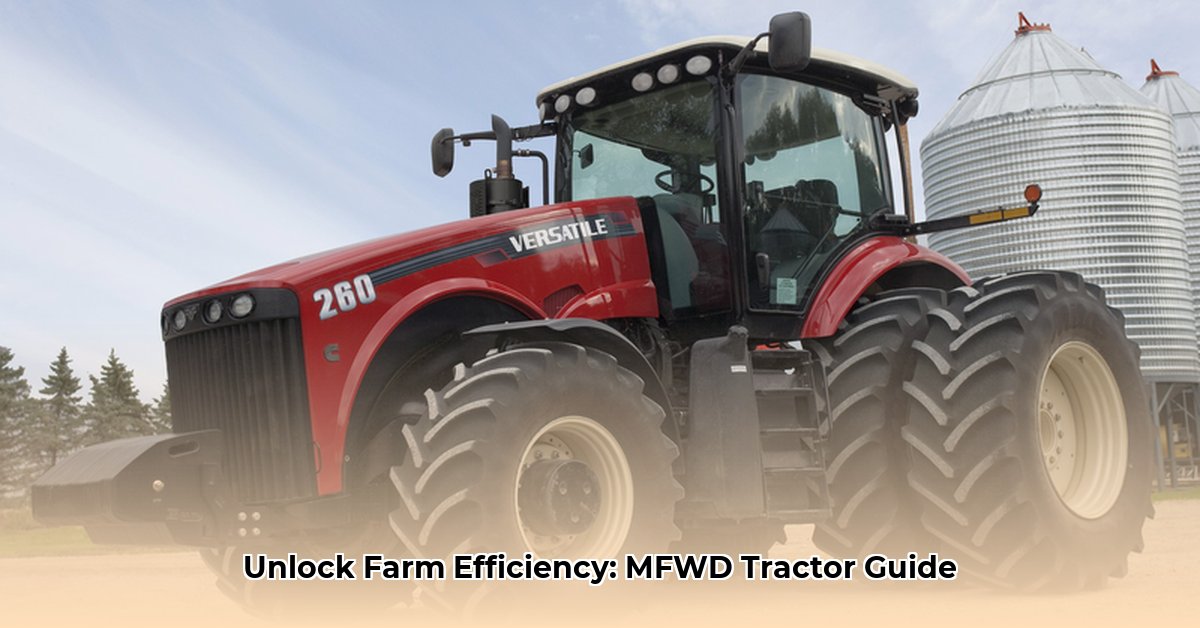
Decoding Tractor Drivetrains: 2WD, 4WD, AWD, and MFWD
Choosing the right tractor drivetrain is crucial for farm efficiency. The terms 2WD, 4WD, AWD, and MFWD often cause confusion due to inconsistencies in their usage across manufacturers. This guide focuses on the functional differences to help you make an informed decision. For financing options, check out our guide on tractor financing.
Understanding the Terminology
Let's clarify the terms:
2WD (Two-Wheel Drive): Power is transmitted to the rear wheels only. Simple, cost-effective, but limited traction in challenging conditions. Think of it as a bicycle – efficient on paved roads, but struggles off-road.
4WD (Four-Wheel Drive): Power is distributed to all four wheels, providing maximum traction. Ideal for heavy-duty tasks and challenging terrains. Think of it as an all-terrain vehicle – powerful, but less fuel-efficient.
AWD (All-Wheel Drive): Similar to 4WD, but often incorporates advanced technology for automatic power distribution to wheels with the best grip. This results in enhanced traction and stability. Think of it as a 4WD with smart technology – maximizing traction in changing conditions.
MFWD (Mechanical Front-Wheel Drive): Power primarily goes to the rear wheels, with additional mechanical power sent to the front wheels when needed, enhancing traction. This system balances power and maneuverability. Think of it as a versatile hybrid – offering a better compromise between power and fuel efficiency.
Traction: Conquering Challenging Terrain
Traction is paramount, especially in wet, muddy, or hilly fields. Here’s a qualitative comparison:
2WD: Excellent on firm, flat ground. Expect significant wheel slippage and reduced efficiency in wet soil, mud, or on slopes.
4WD: Provides superior grip in almost all conditions, excelling in mud, snow, and on steep slopes.
AWD: Often surpasses 4WD in traction due to its intelligent power distribution, minimizing wheel spin and maximizing power to the ground.
MFWD: Offers a significant improvement over 2WD, particularly in wet or hilly conditions. While not matching the raw power of a 4WD in extreme situations, MFWD provides a good balance between traction and fuel economy.
Maneuverability: Navigating Tight Spaces
Maneuverability is key for efficient operation in confined areas:
2WD: Generally offers the best maneuverability due to its simpler drivetrain. This is a crucial factor for smaller fields and precise operations.
4WD & AWD: Often have larger turning radii than 2WD, although advanced steering technologies mitigate this in many models.
MFWD: Usually falls between 2WD and 4WD, offering a good compromise between traction and maneuverability.
Task Suitability: The Right Tractor for the Job
Matching the drivetrain to the task is critical:
| Drivetrain | Plowing | Planting | Harvesting | Hauling |
|---|---|---|---|---|
| 2WD | Limited | Suitable for flat fields | Limited | Suitable for flat, dry conditions |
| 4WD | Excellent | Excellent | Excellent | Excellent |
| AWD | Excellent | Excellent | Excellent | Excellent |
| MFWD | Good | Good | Good | Good |
Cost and Maintenance: Balancing Performance and Budget
Consider the initial investment and long-term costs:
2WD: Lowest purchase price and maintenance costs.
4WD & AWD: Higher initial cost and more complex/expensive maintenance.
MFWD: Generally falls between 2WD and 4WD in terms of both purchase price and ongoing maintenance.
Choosing the Right Drivetrain: A Step-by-Step Guide
Assess Your Soil and Terrain: Are your fields predominantly flat and dry, or do you have slopes, wet soil, or heavy mud?
Define Your Primary Tasks: Will your tractor mostly perform light tillage operations, or will it handle heavy plowing, hauling, and other demanding tasks?
Set Your Budget: Consider the initial investment and the anticipated cost of fuel and maintenance over the tractor's lifespan.
Evaluate Maneuverability Needs: Do you need a highly maneuverable tractor for working in tight spaces, or is maneuverability less of a concern?
Consult with Experts: Discuss your needs with local farmers, dealers, and agricultural equipment specialists for personalized recommendations.
Key Considerations:
- Terrain greatly influences choice: Hilly or wet conditions necessitate a 4WD, AWD, or MFWD system.
- Task prioritization: Select a drivetrain suited to your most common farming tasks.
- Budget is a major factor: Consider both purchase price and long-term maintenance costs.
- Maneuverability impacts efficiency: Assess your field layout and space requirements before making your final decision.
This guide provides a framework for choosing the optimal drivetrain. Remember to conduct thorough research and seek expert advice to make the best decision for your farm's unique needs.